Unlocking
User interface panel titled Patient Treatment Plan with an unlocked padlock icon in blue gradient.
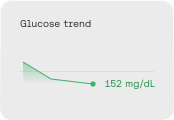
User interface panel titled Glucose trend with a curve
High-Quality,
Continuous
User interface panel showing different health indicators
Care

Updoc's mission
Updoc's mission
Our mission is to usher in a new era of healthcare where physicians and Clinical AI agents work side by side.
Abstract blue shapes with white stethoscope icons lead to a larger purple circle with a medical cross.
how we do it
By extending the reach of evidence-based medicine, patients receive timely, high-quality interventions when it matters most.
Blue circle with app icon center and text: Blood sugar above goal, No reported symptoms, Medication adherence 100%.
how we do it
Updoc's beliefs
We believe AI's role in healthcare is not to replace doctors, but to amplify their impact.
Central white stethoscope icon on blue gradient circle with six smaller purple circles with plus symbols.

Leadership

Sharif Vakili, MD, MBA, MS

Sharif Vakili, MD, MBA, MS

Chief Executive Officer
Ashwin Nayak, MD, MS

Ashwin Nayak, MD, MS

Chief Technology Officer
Kendal Dinsmore, MBA

Kendal Dinsmore, MBA

VP, Regulatory Affairs and Quality Assurance
Kristen Nayak, MD

Kristen Nayak, MD

Medical Director
David Dupee, MD, MBA

David Dupee, MD, MBA

Director of Clinical Affairs

Investors & Advisors

Andy Conrad, PhD

Andy Conrad, PhD

General Partner, S32; Founder and Former CEO, Verily Life Sciences (Alphabet)
Gary Swart

Gary Swart

Operating Partner, Polaris Partners
Kevin Schulman, MD, MBA

Kevin Schulman, MD, MBA

Professor of Medicine, Stanford University; Deputy Director, Clinical Excellence Research Center
Robert Califf, MD

Robert Califf, MD

Former Commissioner, U.S. Food and Drug Administration
Robert Gabbay, MD, PhD

Robert Gabbay, MD, PhD

Former Chief Scientific and Medical Officer, American Diabetes Association
William Shrank, MD, MSHS

William Shrank, MD, MSHS

Co-Founder & CEO, Aradigm; Former Chief Medical Officer, Humana; Former CMO, UPMC Health Plan
our story

UpDoc was founded by physicians who experienced firsthand the growing disconnect between what medicine knows how to
do and what the healthcare system is actually able to deliver.

01

Sharif and Ashwin first met during medical training, where they quickly saw that one of healthcare’s biggest challenges was a limited capacity to maintain high-quality care in between appointments. There was little to no infrastructure to support patients in the day-to-day needs of managing their health – they were essentially on their own.

02

The two of them witnessed the RPM industry emerge as a potential solution with initial promise, but ultimately failed to change care. RPM centered on data collection and billing compliance without clear integration into physician workflows. The result: more data without better care. At the same time, providers were strained by burnout, staffing shortages, and ever increasing demand.

03

They envisioned a thoughtfully designed, physician-prescribed AI system that could close this gap – extending clinicians' reach while preserving the doctor–patient relationship.

04

Their platform would need to:

  • Comprehensively serve patients with chronic conditions who need help the most

  • Integrate seamlessly into cliniciansʼ existing EHR workflows, becoming a natural part of their day

  • Provide high quality care that democratizes the latest evidence-based medicine

  • Set the standard for trust within the healthcare ecosystem, with input from medical societies, patients, health systems, regulators, and technologists

05

They knew the solution needed to be practical and grounded in clinical reality, so they drew on their training and expertise in medicine and AI to build a platform that achieved this.

And UpDoc
was founded

Our Principles

Patients Come First

Every decision, from design to deployment, begins and ends with the patient.

Quality, No Compromise

We build FDA-regulated systems that prioritize safety, transparency, and clinical integrity.

Simplicity That Scales

Clinical AI meets patients where they are, with the tools and systems they are comfortable using.

Physician-Led by Design

Built by clinicians for clinicians, with deep respect for real-world workflows and constraints.

Rigor Over Hype

We focus on creating clinical impact and don't get distracted by buzzwords.

Accountability Always

From engineering to clinical operations to leadership — responsibility is at every level.

Kevin Schulman, MD, MBA

Professor of Medicine, Stanford University; Deputy Director, Clinical Excellence Research Center

Kevin Schulman is a Professor of Medicine at Stanford University and Professor of Operations, Information and Technology at Stanford Graduate School of Business. He serves as Deputy Director of Stanford's Clinical Excellence Research Center and is one of the most cited health economists in academic medicine, with more than 500 peer-reviewed publications.

Dr. Schulman's work spans healthcare economics, payment reform, and technology-enabled care delivery. He was principal investigator of the Stanford clinical trial published in JAMA Network Open that provided the foundational evidence for Remote Patient Intervention, and is a co-author of the NEJM Catalyst paper establishing UpDoc's AI-driven payment framework.

He holds an MD from New York University School of Medicine and an MBA from the Wharton School of the University of Pennsylvania.

Gary Swart

Operating Partner, Polaris Partners

Gary Swart is an Operating Partner at Polaris Partners, the venture capital firm that led UpDoc's founding investment round, where he invests in technology and healthcare companies from the firm's San Francisco office. He has served on the boards of companies across enterprise software, marketplace platforms, and health technology.

Prior to joining Polaris, Gary was CEO of Upwork (formerly oDesk) for nearly a decade, building it into the world's largest online workplace with more than $1 billion in work transacted through the platform and more than ten million registered freelancers. He guided the company through its merger with Elance to form Upwork in 2014.

He holds a BS in Business from the University of Maryland.

Andy Conrad, PhD

General Partner, S32; Founder and Former CEO, Verily Life Sciences (Alphabet)

Andy is a General Partner at S32, a venture capital firm investing at the frontiers of technology.

Prior to S32, Andy founded and served as CEO and Executive Chairman of Verily, Alphabet's life sciences company. He also held leadership roles across Google's innovation ecosystem, including GV, X, DeepMind, Google Cloud, and Google AI, and continues to serve as an advisor to Google.

Before Google, Andy was Chief Scientific Officer of LabCorp. He previously co-founded the National Genetics Institute, which grew rapidly before its acquisition by LabCorp.

Andy holds a BS in Neurobiology and a PhD in Cell Biology from UCLA.

William Shrank, MD, MSHS

Co-Founder & CEO, Aradigm; Former Chief Medical Officer, Humana; Former CMO, UPMC Health Plan

Will Shrank is Co-Founder and CEO of Aradigm, a company focused on expanding access to novel therapies. He is a physician executive and healthcare leader with deep expertise in value-based care, population health, medication adherence, and healthcare policy.

Previously, Dr. Shrank served as Chief Medical Officer of Humana, where he led clinical operations and population health strategy, and as CMO of UPMC Health Plan. He also held senior leadership roles at CVS Health and served as Director of the Research and Rapid-Cycle Evaluation Group at the Center for Medicare and Medicaid Innovation, where he helped design early value-based payment models. He later served as a Venture Partner on the Bio + Health team at Andreessen Horowitz.

Dr. Shrank began his career as a practicing internist at Brigham and Women's Hospital and as an Assistant Professor at Harvard Medical School. He holds an MD from Cornell University Medical College, an MS in Health Services from UCLA, and a BA from Brown University.

Robert Gabbay, MD, PhD

Former Chief Scientific and Medical Officer, American Diabetes Association

Robert Gabbay served as Chief Scientific and Medical Officer of the American Diabetes Association from 2020 to 2024, where he led the ADA's scientific agenda, oversaw the Standards of Care, and advanced innovation in diabetes care delivery. Previously, he was Chief Medical Officer and Senior Vice President of Joslin Diabetes Center, overseeing care for more than 25,000 patients with diabetes. He is an Associate Professor at Harvard Medical School.

Dr. Gabbay is an endocrinologist and health services researcher with more than 35 years of experience focused on chronic disease management, patient-centered care, and diabetes registries. He has received funding from NIH, AHRQ, and CMMI.

He holds a BSc from McGill, a PhD from the University of Wisconsin, and an MD from SUNY Brooklyn.

Robert Califf, MD

Former Commissioner, U.S. Food and Drug Administration

Robert Califf served twice as Commissioner of the U.S. Food and Drug Administration, first under President Obama in 2016 and again under President Biden from 2022 to 2025, making him one of the most experienced regulatory leaders in American medicine. Between his FDA tenures, he led medical strategy at Alphabet, helping shape strategy and policy for Verily Life Sciences and Google Health.

Dr. Califf is a cardiologist and clinical trials expert who founded the Duke Clinical Research Institute, one of the world's largest academic clinical research organizations. He is a member of the National Academy of Medicine and has led major initiatives in clinical evidence generation, data science, and healthcare quality.

He holds an MD from Duke University School of Medicine.

Kristen Nayak, MD

Medical Director

Kristen is a practicing primary care physician with expertise in chronic disease management, digital health, and population health informatics. As the Medical Director of UpDoc, she drives the clinical excellence behind the platform’s ability to deliver evidence-based medicine at scale.

She is a co-investigator on the landmark RCT that first demonstrated the efficacy of Remote Patient Intervention and has publications in JAMA Internal Medicine and American Family Physician. She is a Clinical Assistant Professor at Stanford University School of Medicine.

Kristen completed her family medicine residency at Stanford and holds an MD from the University of Illinois at Chicago College of Medicine.

David Dupee, MD, MBA

Director of Clinical Affairs

David is a practicing psychiatrist and clinical innovator with deep experience at the intersection of medicine, technology, and health system design. He previously led clinical strategy at Flock Health and served as Director of Strategy at Stanford’s Brainstorm Lab. He is Adjunct Clinical Faculty at Stanford University School of Medicine and served as Chief Resident during his psychiatry residency at Stanford Health Care.

He holds an MD and MBA from Yale University and a BA in Biology and History from Cornell University.

Kendal Dinsmore, MBA

VP, Regulatory Affairs and Quality Assurance

Kendal brings more than 20 years experience in regulatory affairs, quality leadership, and operations across biotechnology, medical devices, and software-as-a-medical-device (SaMD). He has guided early and growth stage companies through FDA regulatory processes and quality system development. Prior to UpDoc, he served as Vice President of Regulatory and Quality at Mahana Therapeutics and held senior regulatory, quality, and compliance roles at Counsyl (Myriad Women’s Health), Complete Genomics, and Specific Technologies.

Kendal holds an MBA from Pepperdine and a BA in Biology from Sonoma State University.

Ashwin Nayak, MD, MS

Chief Technology Officer

Ashwin is a physician-engineer with deep expertise in machine learning and clinical informatics. He is a leading AI researcher with publications in major academic journals including JAMA Internal Medicine and Nature Digital Medicine.

Ashwin built the first Remote Patient Intervention (RPI) system, one of the earliest implementations of Clinical AI integrated directly into care delivery. He is the co-founder and CTO of UpDoc and a Clinical Assistant Professor at Stanford where he currently practices as a hospitalist.

He completed his internal medicine residency at Stanford, holds an MD from the University of Illinois College of Medicine, and an MS in Clinical Informatics Management from Stanford.

Sharif Vakili, MD, MBA, MS

Chief Executive Officer

Sharif is a primary care physician, serial healthcare entrepreneur, and former VC at Polaris Partners, where he served on the boards of biotechnology and health services companies.

Sharif pioneered Remote Patient Intervention (RPI), an AI-driven care model first validated at Stanford and published in JAMA Network Open. His work helped establish the field of Clinical AI. He is the co-founder and CEO of UpDoc, serves on Stanford's clinical faculty, and teaches at the Stanford Graduate School of Business.

Sharif completed his medical training at Stanford, holds an MD from Johns Hopkins, an MBA from Harvard, and an MS and BS in Biology from Yale.